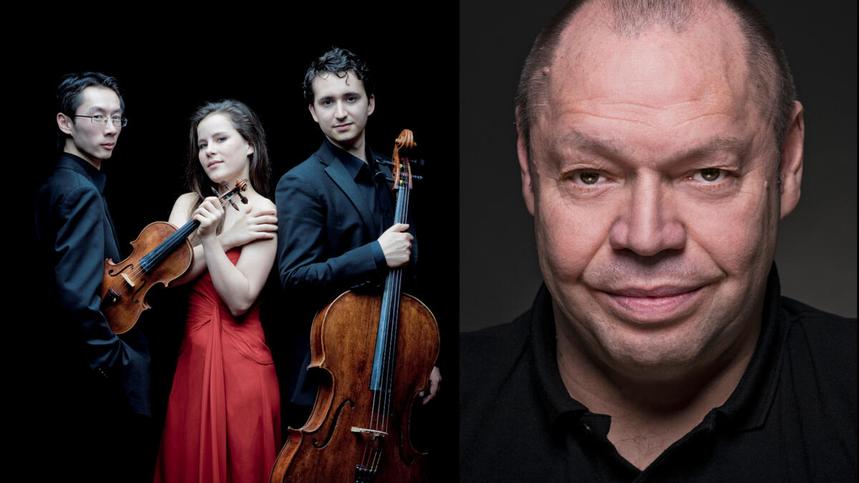
Thomas Quasthoff & Amatis Trio
—Humanity in war
- Palau Cambra
20October2026
Tuesday
20:00
Concert Hall
From the World Wars to Messiaen and Pärt: music, resistance and hope in the face of catastrophe
Thomas Quasthoff & Amatis Trio
—Humanity in war
20October2026
Tuesday
20:00
Concert Hall

Trio Fortuny & Cristina Mateo
—Part and Messiaen
22October2026
Thursday
19:30
Petit Palau Hall
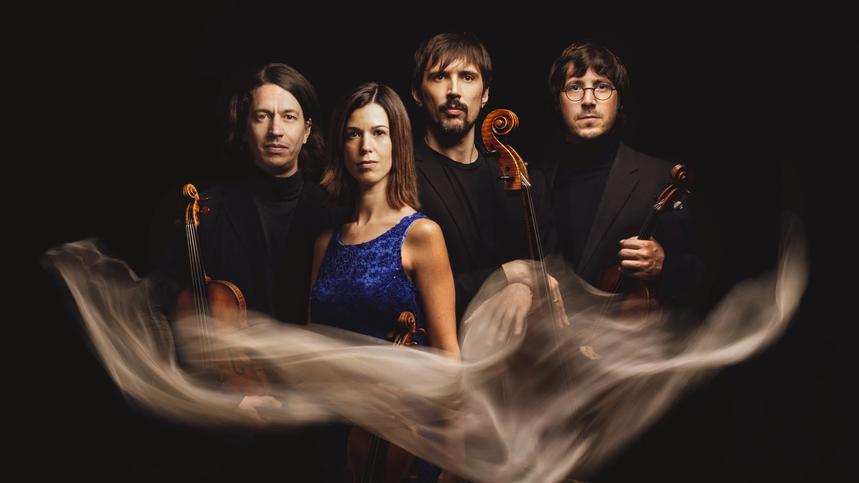
Quartet Gerhard
—Complete Shostakovich Quartets (I)
3November2026
Tuesday
19:30
Petit Palau Hall
Music in the Face of History’s Rupture
Stefan Zweig recounts in his celebrated autobiographical work The World of Yesterday how, on the afternoon of 28 June 1914, while reading peacefully in a park in Baden, he could hear a band playing music that suddenly came to an abrupt halt. As the musicians left the bandstand, a crowd gathered around a telegram: the heir to the throne of the Austro-Hungarian Empire, Archduke Franz Ferdinand, had been assassinated in Sarajevo. This is how history bursts in and brings music to a halt.
The world, once seemingly safe and permanent, was hurtling towards unforeseen events that would culminate in the First World War, traumatising an entire generation and confronting artists with an enormous challenge: how to create and live in a world that is suddenly falling apart.
The shattering of the illusion of a stable world found a paradigmatic example in Fritz Kreisler: a prodigious violinist and emblematic figure of a musically ideal(ised) Vienna, who ended up serving in a regiment dispatched to the Eastern Front during the opening stages of the Great War. Kreisler went from the sweet, melodic and immortal Vienna of his music to giving his memoirs the title Four Weeks in the Trenches: The War Story of a Violinist. His Alt-Wiener Tanzweisen, or Old Viennese Dances, ultimately became a nostalgic musical postcard of a world bidding farewell. Or, rather, of the image of a world that would be sorely missed.
This tradition was also embraced by Erich Wolfgang Korngold, whose music took refuge in a vibrant theatricality that would lead him, in the 1930s, to compose film scores during Hollywood’s first golden age. The incidental music that brought smiles to Vienna in the twilight of its existence stands in stark contrast to the rupture embodied by Anton von Webern and the idea that music had shattered into particles. The continuity with Europe’s great cultural tradition in Korngold’s Shakespeare-inspired Much Ado About Nothing stands against the fragmentation and compressed world of Webern’s Three Little Pieces. Grand, exuberant narratives that seduce the ear are set against the stark reduction to essentials heralded by the modernity of the turn of the century. Both are conscious strategies for adapting to a new reality, meeting at a historical and creative crossroads: two ways of inhabiting the world.
After all, The Ninth Duino Elegy by Rainer Maria Rilke, begun in 1912, interrupted for several years and eventually published after the First World War, reflects on everything that is ephemeral, unique and absolute, with the decisive line “Hiersein ist viel”. Being here is much. Often, simply being here is the greatest challenge one can undertake.
If anyone embodies the artist’s existential elegy through this same idea of being here, trapped within the circumstances of his time, it is Dmitri Shostakovich. In his case, it is a matter of personal resistance when catastrophe is not merely public but also a private threat. The old world has vanished, replaced by a history that once again intrudes with severity, forcing the artist into a delicate balancing act with those in power. Music does not merely bear witness to the world; it struggles to exist even as history threatens to crush it.
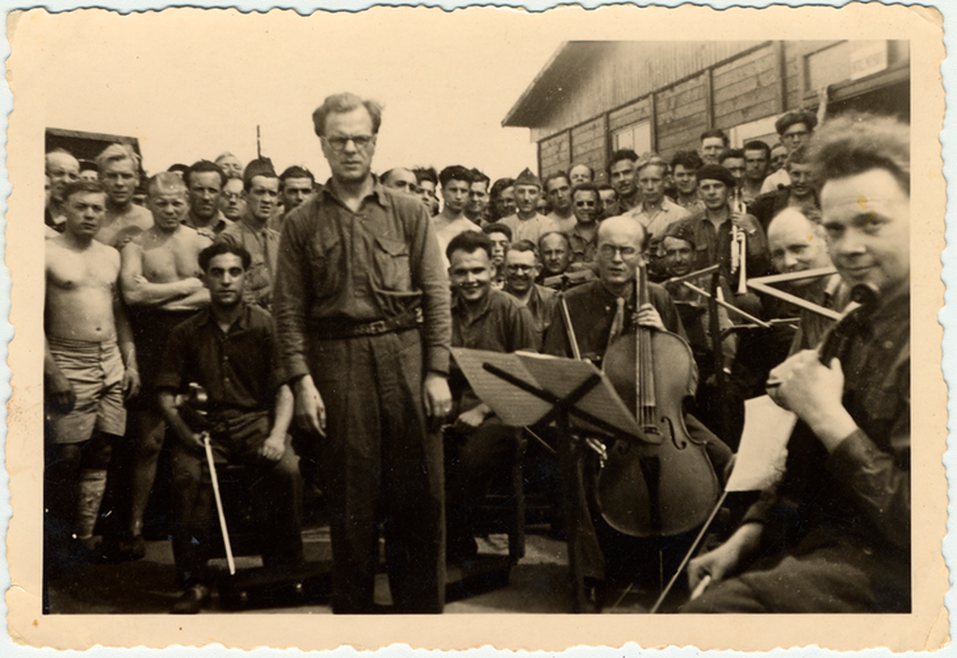
Yet the First World War would eventually be followed by something even worse: the Second World War. “There shall be time no longer,” proclaims the Book of Revelation. “There will be no more delay,” according to other translations, introducing a subtly different meaning. In any case, this is no arbitrary quotation with which to introduce the devout Catholic and musical genius Olivier Messiaen. Historical time fades before eternity. The legendary and turbulent Quartet for the End of Time, premiered under makeshift conditions at prisoner-of-war camp VIII-A, proclaims that the horizon as we know it is no longer possible or, at the very least, imaginable. The devastation overwhelms everything, and we contemplate it as one might listen to the birds so beloved by Messiaen the ornithologist. The limit would seem to lie here. The end of musical time (with its turbulent, irregular rhythms) connects with the end of time in the world itself.
Yet even then, music finds a way forward, discovering a crack in the concrete. Remaining within the realm of faith, Arvo Pärt offers the possibility of communion. Faced with Messiaen’s vision of the end of time, the Estonian composer constructs, with Spartan rigour, a strict formula for reconnection. His tintinnabuli bring together different voices and axes that generate variations, permanence and an almost circular sense of musical spirituality. His Fratres (Brothers) was composed in 1977, towards the end of a period of creative crisis that had led him to look back to the medieval world. A journey back through time to reconcile the present.
After so much rupture, and once again revisiting spirituality, Psalm 133 could serve as the perfect gateway to his Fratres: “Behold, how good and how pleasant it is for brethren to dwell together in unity.”
Music may not succeed in portraying a perfect world, but it attempts to close the fragile circle that takes us to the heart of the human and musical experience: musicians and audiences coming together to share a moment in time. Never entirely peaceful, perhaps, but possibly fraternal. Making music is a way of being together and making that meeting point possible.