About the course

If we speak in terms of proportions, there is one that is very easy to observe in Beethoven’s output: for every Symphony, the composer left us —approximately— two Quartets and four Sonatas. In his early years in Vienna, Beethoven made his piano sonatas his calling card as a virtuoso: around twenty in just some seven years, while his six Op. 18 quartets paved the way for the first two symphonies. In his middle period, the pace of the sonatas slowed to make way for his most famous symphonies —from the Eroica to the 8th— and the three genres coexisted in balance. In his final years, the symphony became a unique event —the Ninth— and the sonatas disappeared after Op. 111, as he devoted himself obsessively to the string quartets, as the purest form of expression.

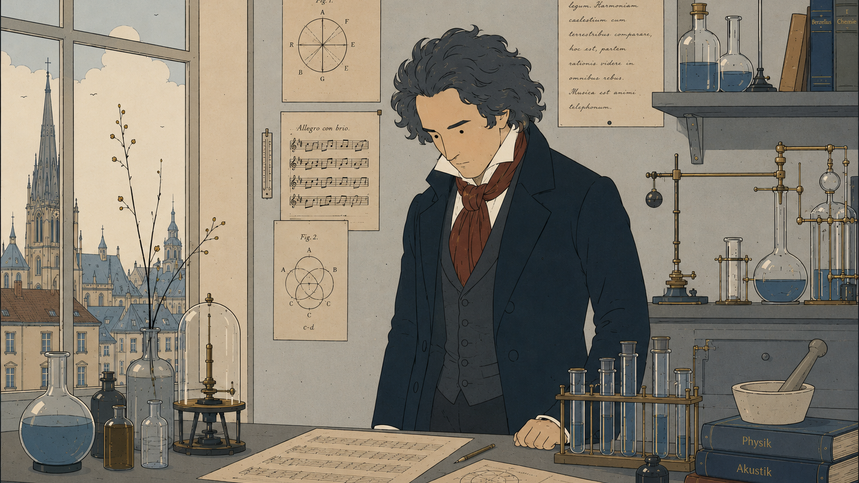
Within the framework of the Complete Beethoven Symphonies conducted by Danielle Gatti, Prof. Carlos Calderón presents a cycle of 6 lectures with numerous sound and multimedia examples to take us inside what we have called the “Beethoven Laboratory”. We will thus enter this “workshop” where the piano is the experimental basis on a personal level; the quartet, a design space for a circle of friends and the symphony, the act of proclamation to the public. At the end of his life, when he no longer had anything to proclaim because his deafness was almost total, nothing to share because his social isolation was almost absolute, he stopped using the piano and the orchestra and remained only with the quartet: four voices that, in reality, were in his mind discussing the limits of beauty and of his own musical laboratory.

Subscribe to the 6 lectures for €125

The Laboratory sets up (3 February 2027 – 6 pm – Petit Palau)

Before Beethoven dared to write a single symphonic note, he had to “domesticate” the forms of Haydn and Mozart. We will analyse how the piano became the sketchbook in which Beethoven first dared to be abrupt and emotional, and how he transferred this energy to his quartets (Op. 18) and the Septet as a testing ground for structure, drama and contrast. Everything is set for the leap onto the public symphonic stage.

Price: €25
Duration: 90 min.

Buy

Various explosions (17 February 2027 – 6 pm – Petit Palau)

The laboratory bears its first public fruits. We will finally see how Sonatas 11 to 20 and the refinement of the Op. 18 quartets lead into these first two symphonies. While we might describe the 1st as an “amplified quartet” and observe how the 2nd begins to use the physical force discovered in the Sonata No. 8 “Pathétique”, the proportions reveal a Beethoven who is still “writing for his time”, yet whose experimentation is already beginning to overflow the classical moulds.

Price: €25
Duration: 90 min.

Buy

Expansion 3 March 2027 – 6 pm – Petit Palau

3 March 2027 – 6 pm – Petit Palau

During this period, the laboratory works at full capacity and reaches its fullest expression. The sonatas, such as the Waldstein and even the Kreutzer violin sonata, together with the Razumovsky Quartets, become the engineering needed to sustain the monumental scale of the Eroica and the driving force of the Fifth. For each symphony, there is prior work at the piano that seeks power and, in the quartet, cohesion. The personal becomes epic: the piano rehearses the “blow” and the quartet rehearses the “tension”.

Price: €25
Duration: 90 min

Buy

Consolidation and freedom 17 March 2027 – 6 pm – Petit Palau

Here we will see how the laboratory becomes freer, with sonatas and quartets that explore new sonorities. Thus, the Sixth and the Seventh coexist with the ideas of the Appassionata and Les Adieux: one impetuous and the other a portrait of separation. Coinciding with these symphonies are the three great late Razumovsky quartets and The Harps: longer works, harmonically more daring. For all these reasons, it is possible to say that Beethoven has already mastered the orchestra and uses it both to “paint” scenes, as in the Sixth, and to generate rhythmic hypnosis, as in the Seventh.

Price: €25
Duration: 90 min

Buy

Humour and Love (13 April 2027 – 6 pm – Petit Palau)

While the Eighth is Beethoven’s shortest and most ironic symphony, the Ninth is his most ambitious and ethical. But all this was prepared in a laboratory that experiments by compressing dramatic tensions and expanding festive energy. “Serious” quartets and “songs of grace”, together with trios such as the Ghost and the Archduke, prepared the contrapuntal densities at the piano, as in the Hammerklavier, and increasingly daring experiments such as his final sonata, op. 111, not to mention the Missa solemnis. In other words, sonatas, quartets and the rest of his work became drafts for conjuring up the monument to peace and friendship that the Ninth Symphony would become.

Price: €25
Duration: 90 min

Buy

Silence and More (12 May 2027 – 6 pm – Petit Palau)

Having reached the summit of the Ninth, Beethoven leaves the outside world behind. This talk focuses on the radical turn towards his final string quartets, from No. 12 to No. 16, including the Grosse Fugue. The laboratory no longer seeks to proclaim or build “monuments”, but nor does it ever close itself off completely. In these final experiments of the Beethoven Laboratory, some saw “horrors” —Spohr—, others the purest and most eternal “contemporaneity” —Stravinsky—, some the deepest “melancholy” —Wagner— and others, an impossibility: “What remains to be written?”, said Schubert. A kindly critic is said to have written: “We know there is something there, but we do not know what it is”. Let’s find out.

Price: €25
Duration: 90 min

Buy

Beethoven Laboratory