Palau and Sant Pau
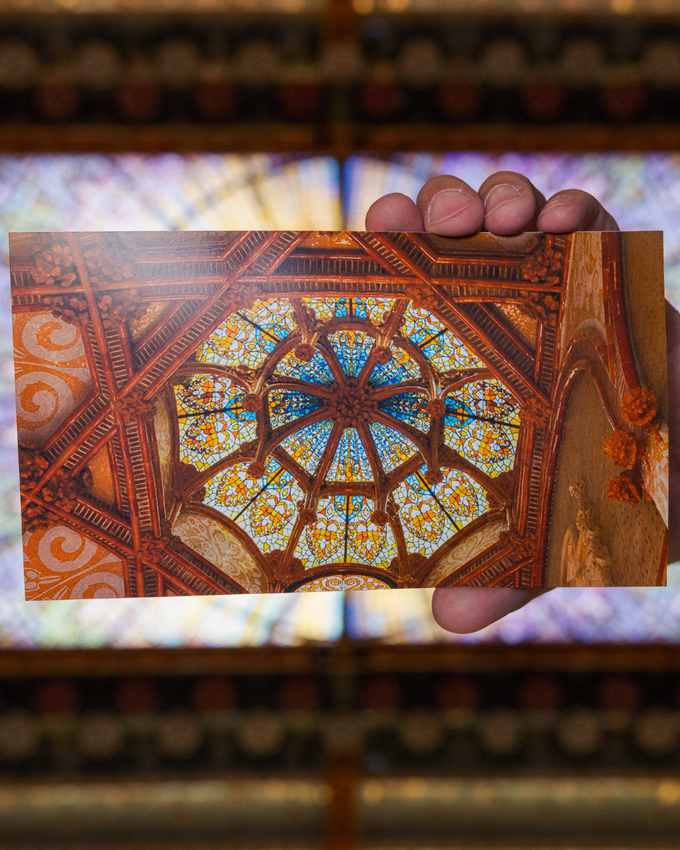
Visit two of the most emblematic monuments designed by Lluís Domènech i Montaner with a combined ticket.
Discover the history and architectural details of the Palau de la Música Catalana and the Sant Pau Art Nouveau Site at a reduced price.
The Palau, a jewel of Catalan modernism, stands out for its central iron and glass structure, which transforms natural light into a magical music box where sculpture, mosaic, glass and iron come together in harmony. Meanwhile, the Sant Pau Art Nouveau Site invites visitors to explore the world’s largest Modernist complex, with twelve pavilions set within gardens and connected by underground galleries. Once a hospital, nowadays it is a masterpiece of rational and innovative design.
- Combined ticket
- Reduced ticket price
- Self-guided visit with brochure support
- Available languages: Aranese, Catalan, Spanish, English, French, Italian, Galician, German, Portuguese, Russian, Japanese, Korean, Chinese, Arabic, Hebrew, Polish and Basque
- Date and time of your choice
- Priority access
- Combined ticket
with access to both buildings - Two modernist jewels
by Domènech i Montaner - Day and time of your choice
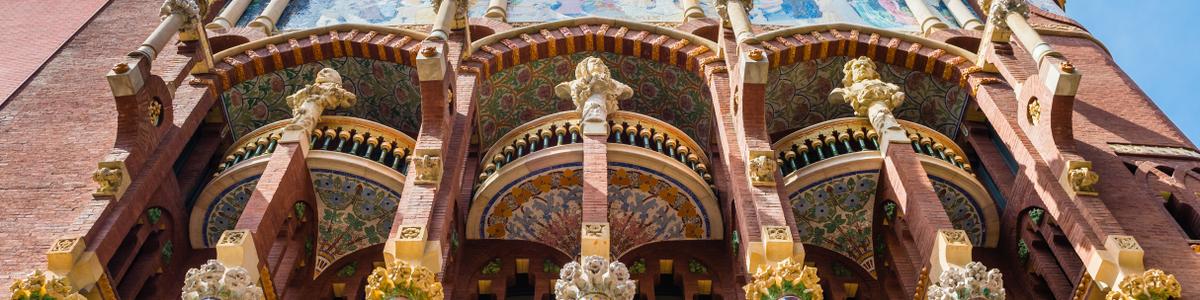
What does the visit include?
The combined ticket includes a self-guided visit to the Palau de la Música Catalana, supported by a brochure available in 17 languages.
It also includes the visit to the Sant Pau Art Nouveau Site, with digital map support and assistance from information staff available throughout the site.
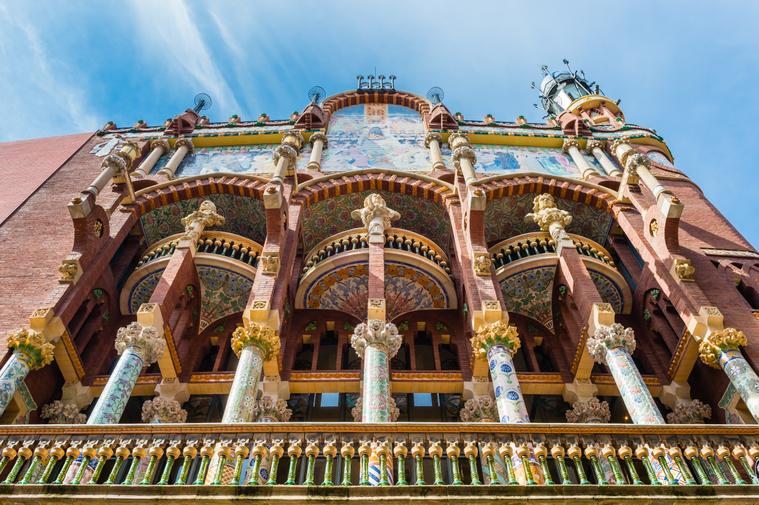
The Palau façade
The Palau’s intricate façade features a wealth of allegorical figures, sculptures and architectural elements characteristic of Catalan modernism.
On the first floor, a balcony runs along the façade, supported by fourteen paired columns decorated with mosaic, each with a unique design. On the second floor are busts of musicians by Eusebi Arnau: from left to right, Palestrina, Bach and Beethoven; beyond the sculptural group on the corner stands the bust of Wagner, now located on Carrer d’Amadeu Vives. The façade is crowned by a large mosaic pediment by Lluís Bru.
At the corner, the sculptural group La cançó popular catalana by Miquel Blay depicts Saint George beneath a central female figure, an allegory of music, surrounded by characters representing a sailor, peasants, an elderly man and children.
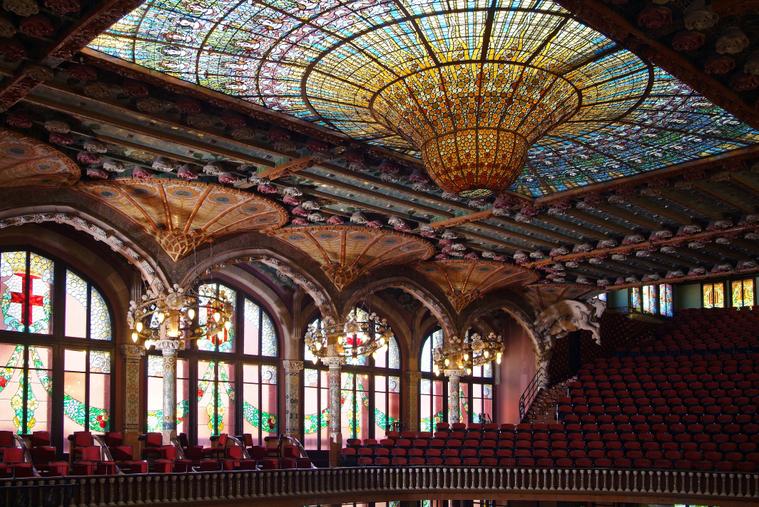
Concert Hall
This century-old hall has hosted some of Barcelona’s most important musical events throughout its history.
Dominated by the organ above the stage and crowned with a central skylight representing the sun, the hall is filled with natural light.
Both mystical and striking, it is rich in figures and symbolic detail: the muses surrounding the stage, Wagner’s Valkyries emerging from the ceiling, a bust of Anselm Clavé on one side and one of Beethoven on the other, alongside elements drawn from nature such as flowers, palm trees and fruit.
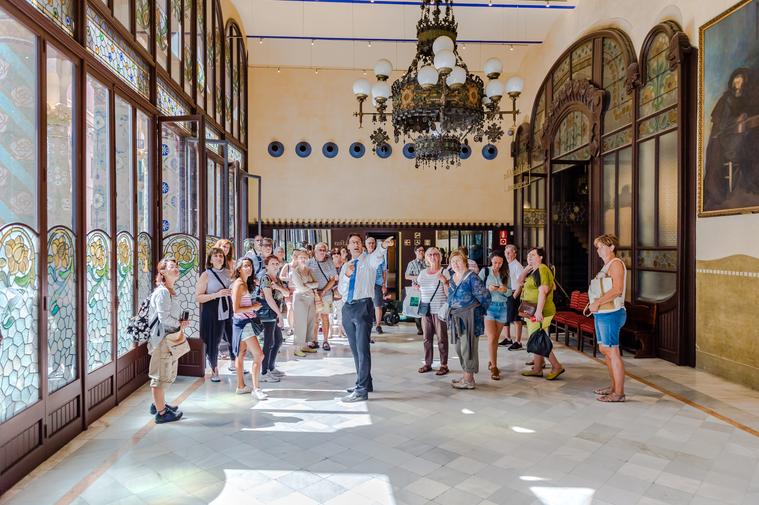
Lluís Millet Hall
The grand hall, dedicated to the founder of the Orfeó Català, is adorned with beautiful stained glass and opens to a balcony richly decorated with mosaics.
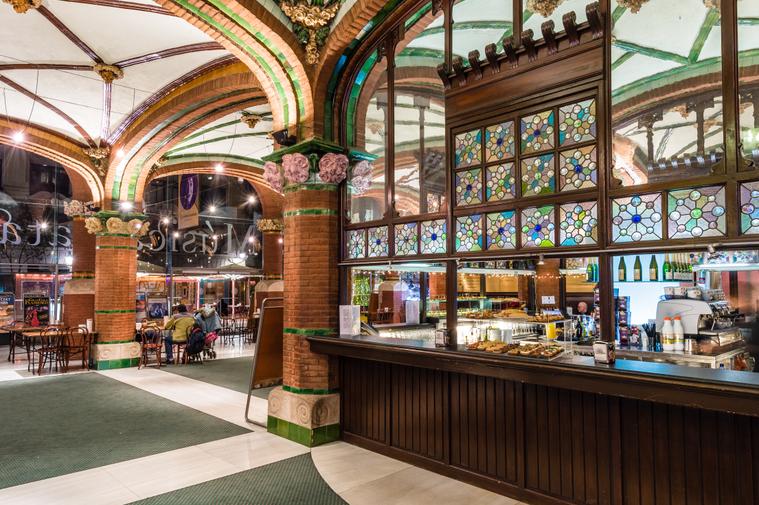
Palau Foyer
Now home to a café-restaurant, this space retains striking architectural features, including brick arches decorated with ceramic detailing.
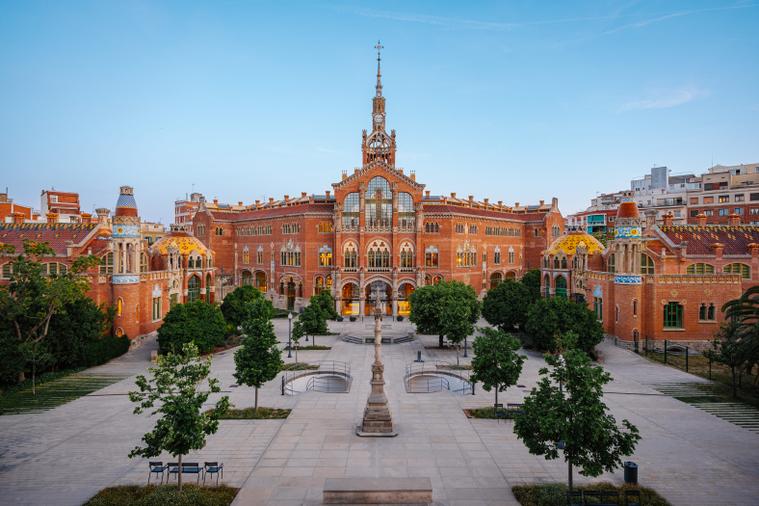
Gardens of the Sant Pau Art Nouveau Site
The gardens are an essential part of the architectural project conceived by Lluís Domènech i Montaner. The presence of nature reflects both the aesthetic sensitivity of Catalan modernism and a therapeutic function. The green spaces follow the garden city model developed in the early 20th century, integrating pavilions, pathways and rest areas.
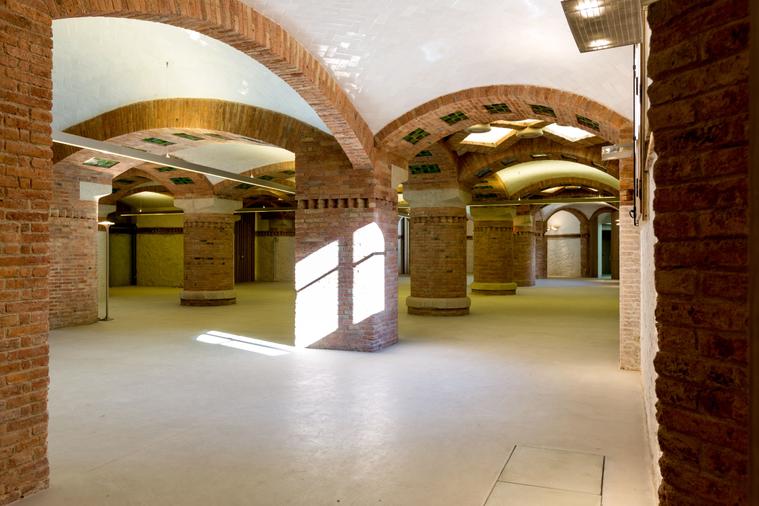
Hypostyle Hall
The Hypostyle Hall formerly housed the emergency services of the Sant Pau Hospital. It is a large open space structured around numerous columns supporting the roof. Exposed brick and ceramic, characteristic materials of Catalan modernism, define the aesthetic of this space.
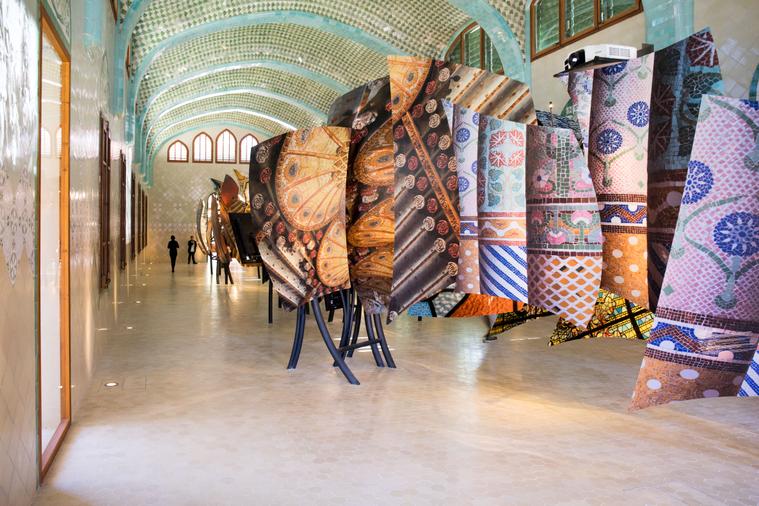
Sant Salvador Pavilion
This was the first building in the hospital complex to come into operation in 1916. It now houses an exhibition space dedicated to the history of the former Hospital de la Santa Creu i Sant Pau, one of the oldest healthcare institutions in Europe.
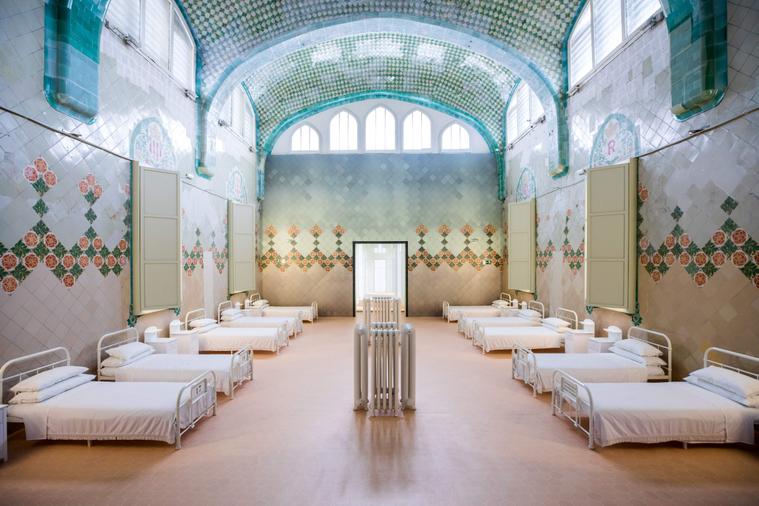
Sant Rafael Pavilion
This pavilion allows visitors to observe how a hospital space for patients was organised in the 1920s, recreating its original atmosphere. The building is named after Domènech i Montaner’s son, who died during the construction of the site.
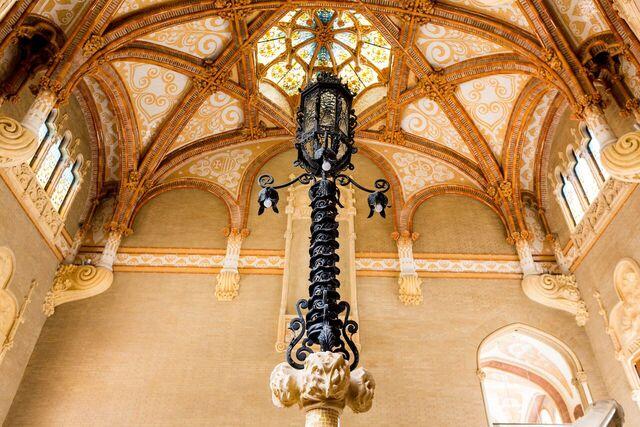
Administration Pavilion
The most monumental building in the Sant Pau Art Nouveau Site. Inside, several heritage rooms are preserved where mosaics, sculptures, stained glass and other ornamental elements form a richly ornate ensemble.
Schedule
At the time of booking, visitors must select the date and time for the Palau visit. Entry to the Sant Pau Art Nouveau Site is flexible, upon presentation of the same ticket used for the Palau.
Palau de la Música: 9.00 am to 3.30 pm
Sant Pau Art Nouveau Site: 9.00 am to 6.30 pm (April to October) and 9.00 am to 5.00 pm (November to March). Last entry 30 minutes before closing.
Rates
- General admission: €32
- Children under 12: free admission
Online purchase benefits
- Skip the ticket office queue
- Box office price: +€2 per ticket
Languages
The Palau and Sant Pau visit is available in the following languages:
- Aranese
- Catalan
- Spanish
- English
- French
- Italian
- Galician
- German
- Portuguese
- Russian
- Japanese
- Korean
- Chinese
- Arabic
- Hebrew
- Polish
- Basque
Accessibility
The visit is fully accessible for visitors with reduced mobility, with lift access to all floors.